\(\renewcommand{\AA}{\text{Å}}\)
pair_style body/rounded/polyhedron command
Accelerator Variants: body/rounded/polyhedron/omp
Syntax
pair_style body/rounded/polyhedron c_n c_t mu delta_ua cutoff keyword
c_n = normal damping coefficient
c_t = tangential damping coefficient
mu = normal friction coefficient during gross sliding
delta_ua = multiple contact scaling factor
cutoff = global separation cutoff for interactions (distance units), see below for definition
zero or more keywords may be appended
keyword = history
  history = keep track of the tangential deformation at the contacts (no value)
Examples
pair_style body/rounded/polyhedron 20.0 5.0 0.0 1.0 0.5
pair_coeff * * 100.0 1.0
pair_coeff 1 1 100.0 1.0

pair_style body/rounded/polyhedron 20.0 5.0 0.5 1.0 0.5 history
pair_coeff * * 100.0 1.0 30.0
Description
Style body/rounded/polyhedron is for use with 3d models of body particles of style rounded/polyhedron. It calculates pairwise body/body interactions which can include body particles modeled as 1-vertex spheres with a specified diameter. See the Howto body page for more details on using body rounded/polyhedron particles.
This pairwise interaction between the rounded polyhedra is described in Wang, where a polyhedron does not have sharp corners and edges, but is rounded at its vertices and edges by spheres centered on each vertex with a specified diameter. The edges of the polyhedron are defined between pairs of adjacent vertices. Its faces are defined by a loop of edges. The sphere diameter for each polyhedron is specified in the data file read by the read data command. This is a discrete element model (DEM) which allows for multiple contact points.
Note that when two particles interact, the effective surface of each polyhedron particle is displaced outward from each of its vertices, edges, and faces by half its sphere diameter. The interaction forces and energies between two particles are defined with respect to the separation of their respective rounded surfaces, not by the separation of the vertices, edges, and faces themselves.
This means that the specified cutoff in the pair_style command is the cutoff distance, \(r_c\), for the surface separation, \(\delta_n\) (see figure below). This is the distance at which two particles no longer interact. If \(r_c\) is specified as 0.0, then it is a contact-only interaction. I.e. the two particles must overlap in order to exert a repulsive force on each other. If \(r_c > 0.0\), then the force between two particles will be attractive for surface separations from 0 to \(r_c\), and repulsive once the particles overlap.
Note that unlike for other pair styles, the specified cutoff is not the distance between the centers of two particles at which they stop interacting. This center-to-center distance depends on the shape and size of the two particles and their relative orientation. LAMMPS takes that into account when computing the surface separation distance and applying the \(r_c\) cutoff.
The forces between vertex-vertex, vertex-edge, vertex-face, edge-edge, and edge-face overlaps are given by:
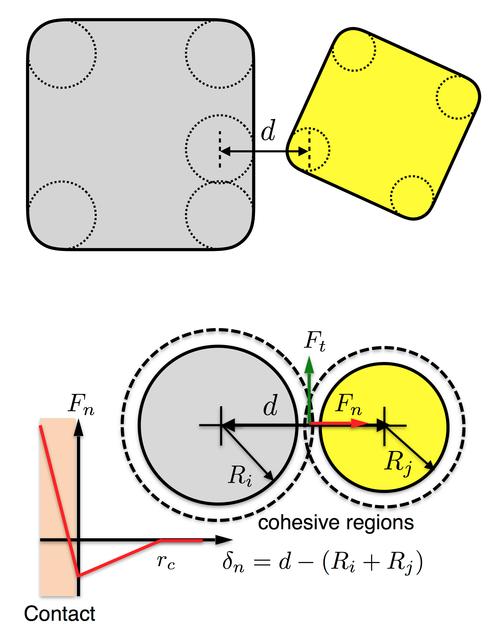
Here, positive values of \(F_n\) are repulsive. The cohesive force \(k_{na} (r_c - \delta_n)\) grows with the overlap of the cohesive regions of the two surfaces, also when the surfaces deform. When two particles touch at multiple contact points, the cohesive force at the contacts is scaled by the factor \(j_a \ge 1\), which grows with the area of the contact region (see A_ua), following Wang. The elastic force \(k_n \delta_n\) is not scaled. The damping forces act at each contact, while there is a single friction force per pair of particles, at the contact with the largest overlap times its weight (see below for the weights and the history keyword). The damping and friction forces act at the contact point between the rounded surfaces and depend on the relative velocity of the two particles at that point, including their rotation, so that they also exert torques, e.g. to make spheres roll. Following Wang, a vertex of one particle interacts with a face of the other particle if its projection onto the face lies inside the face, else with the nearest edge if its projection onto that edge lies inside the edge, else with the nearest vertex, where each vertex has at most one such interaction. In addition, the edges of the two particles interact with each other, which takes precedence over the interaction of a vertex at the end of an edge. A vertex interacts with an edge or a vertex only if no edge or face next to either of them is closer to the other particle along the line between the two, else the contact is represented by the interactions of that edge or face. Two parallel edges do not interact as edges, since the ends of their overlap are vertices, which interact instead. A sphere touches a polyhedron at a single point, the point of the polyhedron nearest to the center of the sphere, which can lie on a face, an edge, or a vertex. When the overlap exceeds the contact distance, a vertex, or the center of a sphere, that has penetrated the other particle is pushed out through the face nearest to it, and two edges that have crossed each other are pushed apart along their common normal, so that the repulsion keeps growing with the overlap.
Two nearly parallel faces touch over the region where they overlap, which the contacts represent by its corners: the vertices of either face inside the other face, and the crossings of their edges. The number of corners changes, e.g. when a vertex crosses an edge of the other face and two crossings replace it, or when one face is rotated slightly against the other, which adds four crossings near the middle of the edges. Each such contact would add a full contact force, so the forces would jump. Therefore, the region of overlap of two faces within about 2.5 degrees of parallel is determined as a polygon in the plane halfway between the faces. Each of its corners interacts like the vertex there with the other face, or like the two edges crossing there, with a weight of its exterior angle divided by \(2 \pi / N\), where \(N\) is the larger number of vertices of the two faces. Since the exterior angles of a polygon add up to \(2 \pi\), the weights always add up to \(N\), a corner where the region hardly turns has a small weight, and the corners of a face inside a face of the same shape have a weight of one each, as in Wang. Between 2.5 and 5 degrees, as the region gets narrower than the contact distance, and as the faces penetrate each other by more than the contact distance, the region fades out, and the individual contacts of the vertices and edges take over. Similarly, the crossing of two edges within 5 degrees of parallel has a reduced weight, which vanishes for parallel edges, while the contacts at the ends of their overlap keep the remaining weight. These weights also apply to the damping, the friction, the energy, and the contact area of the scaling factor \(j_a\). This deviates from Wang, e.g. two faces of a tetrahedron and a cube in contact interact at up to four corners with a total weight of four, instead of at each corner of the region of overlap with a weight of one, and the weights change as the particles move, so that the forces do not derive exactly from the energy.
In Wang, the tangential friction force between two particles that are in contact is modeled differently prior to gross sliding (i.e. static friction) and during gross-sliding (kinetic friction). The latter takes place when the tangential deformation exceeds the Coulomb frictional limit. Unless the history keyword is used (see below), we do not take into account frictional history, i.e. we do not keep track of how many time steps the two particles have been in contact nor calculate the tangential deformation. Instead, we assume that gross sliding takes place as soon as two particles are in contact.
Changed in version 30Sep2026.
The friction term in \(F_t\) acts in the tangential direction, opposite to the tangential relative velocity \(v_t\) at the contact point, with a magnitude of \(\mu\) times the elastic normal force \(k_n |\delta_n|\), but at most \(c_t |v_t|\). This limit lets the friction force vanish smoothly as the sliding stops, instead of reversing the sliding direction within a time step, and implies that the friction term requires \(c_t > 0\). Previously, the friction term was applied along the normal direction at every contact and thus only increased the normal repulsion. Also, the scaling factor \(j_a\) now applies only to the cohesive force as in the reference model, instead of to the whole normal force, and the cohesive force keeps growing when the surfaces deform, instead of staying constant. The damping and friction forces now act at the contact point between the rounded surfaces, instead of at the vertices, and the friction force now also applies to spheres. Contacts between a vertex and an edge or between two vertices are now detected, both triangles of a quadrilateral face are tested for edges crossing the face, and the cohesive force is also scaled for two contact points. A vertex no longer interacts with an edge or a vertex when an edge or face next to them is closer, and two parallel edges no longer interact with each other at a single point in the middle or at an end of their overlap. Previously, edges within about 2.6 degrees of each other were treated as parallel. These contacts pushed particles resting with a face on each other sideways and made them rotate, and made the forces jump as the particles moved. A sphere now also interacts with the vertices of a polyhedron, instead of passing through its corners, and interacts only once with a polyhedron, instead of with both a face and the edges of that face near its boundary. The contacts of nearly parallel faces and edges are weighted as described above, so that the forces no longer jump as a particle resting on a face is rotated or moved, and a vertex interacts only with the face nearest to it. The energy and the damping of two contacts at the same point are counted once, as their force. A vertex or a sphere that has penetrated the other particle, and two edges that have crossed each other, are now pushed out instead of further in, and a rod lying on a face no longer falls through it.
Added in version 30Sep2026.
With the history keyword, the friction force is instead that of a tangential spring, which also acts prior to gross sliding. The tangential deformation \(\xi\) of each pair of particles in contact is accumulated from their tangential relative velocity, \(\xi \leftarrow \xi + v_t \Delta t\), and the friction force is
with a magnitude of the spring force \(k_t |\xi|\) of at most \(\mu \sum k_n |\delta_n|\), the sum of the elastic normal forces of all contacts of the pair. Once the spring force exceeds this limit, the particles slide and \(\xi\) is reduced accordingly. There is still a single friction force per pair of particles, but it acts at the average of the contact points of the pair, and \(v_t\) and the contact normal are averages over the contacts as well, all weighted by the elastic normal forces of the contacts. This deviates from Wang, where the friction force acts at the contact with the largest overlap. With that choice, the friction force jumps between contacts whenever the contact with the largest overlap changes, so that e.g. a particle resting with a face on another particle under a sideways load keeps rocking instead of coming to rest. Since the contact normal changes as the particles move and rotate, \(\xi\) is rotated into the current tangent plane at each time step, keeping its magnitude, following Eq. 17 of Luding. The tangential deformation is reset to zero when the particles are no longer in contact. As in pair_style gran/hooke/history, the tangential deformations are stored by an internal fix NEIGH_HISTORY. The damping forces are unchanged. This extends the model of Wang and makes static packings of particles with friction possible. The input script in.heap3d in the examples/body directory demonstrates this: cubes and tetrahedra poured onto a floor, with the history keyword also used for fix wall/body/polyhedron, settle into a heap that stays at rest when gravity is tilted by 20 degrees.
The following coefficients must be defined for each pair of atom types via the pair_coeff command as in the examples above, or in the data file read by the read_data command:
\(k_n\) (energy/distance^2 units)
\(k_{na}\) (energy/distance^2 units)
\(k_t\) (energy/distance^2 units) (optional)
Effectively, \(k_n - k_{na}\) and \(k_{na}\) are the magnitudes of the slopes of the lines in the plot above for force versus surface separation, for \(\delta_n < 0\) and \(0 < \delta_n < r_c\) respectively. The tangential stiffness \(k_t\) is used only with the history keyword. If it is not specified, it is set to \(\frac{2}{7} k_n\) as in pair_style gran/hooke/history.
Styles with a gpu, intel, kk, omp, or opt suffix are functionally the same as the corresponding style without the suffix. They have been optimized to run faster, depending on your available hardware, as discussed on the Accelerator packages page. The accelerated styles take the same arguments and should produce the same results, except for round-off and precision issues.
These accelerated styles are part of the GPU, INTEL, KOKKOS, OPENMP, and OPT packages, respectively. They are only enabled if LAMMPS was built with those packages. See the Build package page for more info.
You can specify the accelerated styles explicitly in your input script by including their suffix, or you can use the -suffix command-line switch when you invoke LAMMPS, or you can use the suffix command in your input script.
See the Accelerator packages page for more instructions on how to use the accelerated styles effectively.
Mixing, shift, table, tail correction, restart, rRESPA info
This pair style does not support the pair_modify mix, shift, table, and tail options.
Note
The forces of this pair style do not conserve the total energy, even without damping and friction (c_n = c_t = mu = 0). This is a property of the model of Wang as implemented here:
The contact forces are scaled up with the estimated area of the contact region (controlled by A_ua), but no corresponding energy is defined.
The elastic forces are applied only once for contacts at (nearly) the same place, and the set of contacts between two particles changes abruptly as they move, which changes the forces discontinuously. With cohesion (\(k_{na} > 0\)), the energy of a contact does not vanish when the surfaces just touch, so that these changes also change the energy.
Each vertex interacts with at most one face, edge, or vertex of the other particle, so that a new interaction can appear abruptly with a finite overlap when the vertex moves from the region of one of them to another.
The reported pair energy includes the interactions at all contacts, also those that do not receive an elastic force by the rules above. While such contacts exist, the reported energy does not match the applied forces.
The damping and friction forces dissipate energy as intended. The quantities described next can be used to check the energy balance of a simulation.
Added in version 30Sep2026.
This pair style computes two extra quantities that can be accessed by the compute pair command, as elements 1 and 2 of its global vector. They are the accumulated work (energy units) done since the pair style was defined by two kinds of forces that do not derive from the reported pair energy:
the part of the contact forces added by their scaling with the contact size (controlled by A_ua),
the damping and friction forces (controlled by c_n, c_t, and mu), including the tangential spring with the history keyword.
The first one exists because the model scales the contact forces but not the energy. The kinetic plus potential energy minus these two quantities stays constant during a time integration with fix nve/body, up to the time integration error and to the changes of the set of contacts between two particles, which the model treats as discontinuous. The work is not accumulated during an energy minimization. Note that the kinetic energy must include the rotational energy of the particles, e.g. via compute temp/body with 6 degrees of freedom per particle as in the example below, while the thermo keyword ke includes only the translational part.
compute wp all pair body/rounded/polyhedron
compute tb all temp/body
compute_modify tb extra/dof 0
compute pe all pe
variable etot equal c_tb*6*count(all)/2+c_pe
variable ebal equal v_etot-c_wp[1]-c_wp[2]
This pair style does not write its information to binary restart files. Thus, you need to re-specify the pair_style and pair_coeff commands in an input script that reads a restart file. With the history keyword, the tangential deformations at the contacts are written to the restart file and are used again when the pair style is re-specified with the history keyword.
This pair style can only be used via the pair keyword of the run_style respa command. It does not support the inner, middle, outer keywords.
Restrictions
These pair styles are part of the BODY package. They are only enabled if LAMMPS was built with that package. See the Build package page for more info.
This pair style requires the newton setting to be “on” for pair interactions.
Default
The history keyword is not used, and \(k_t = \frac{2}{7} k_n\).
(Wang) J. Wang, H. S. Yu, P. A. Langston, F. Y. Fraige, Granular Matter, 13, 1 (2011).
(Luding) S. Luding, Cohesive, frictional powders: contact models for tension, Granular Matter, 10, 235 (2008).