compute frenkel command
Syntax
compute ID group-ID frenkel keyword value ...
ID, group-ID are documented in compute command
frenkel = style name of this compute command
zero or more keyword/value pairs may be appended
keyword = drvac or drint or region or rescale or site_file
drvac value = distance for including vacancies in a cluster (unitless multiple of nearest neighbor distance)
drint value = distance for including interstitials in a cluster (unitless multiple of nearest neighbor distance)
region value = ID of a region (or none) to restrict the reference sites to
rescale value = yes or no to co-scale the reference sites with the box
site_file value = name of a file with explicit "x y z" site coordinates (or none)
Examples
compute 1 all frenkel

compute def all frenkel drvac 1.6 drint 1.9 rescale yes
compute sub all frenkel region inner site_file sites.txt
Description
Added in version 2Sep2026.
Define a computation that identifies point defects in a crystal by Wigner-Seitz analysis and counts the number of vacancies and interstitials (i.e.the number of Frenkel pairs) on the fly, without post-processing. This is useful for following radiation-damage cascades, thermal defect formation, or any process that creates or annihilates point defects.
The reference lattice is taken from the most recently defined lattice command: the compute generates one lattice site at every basis point of every unit cell that lies inside the simulation box (exactly as create_atoms would, but without adding any atoms to the system). Each atom in the compute group is then assigned to the nearest lattice site. Atoms that are not in the compute group are ignored and never count as occupants of a lattice site; this can be used, for example, to exclude gas atoms such as helium in tungsten from the analysis. A site with no atoms is a vacancy; a site with two atoms holds an interstitial; a site with more than two atoms is counted as an interstitial and additionally flagged as irregular.
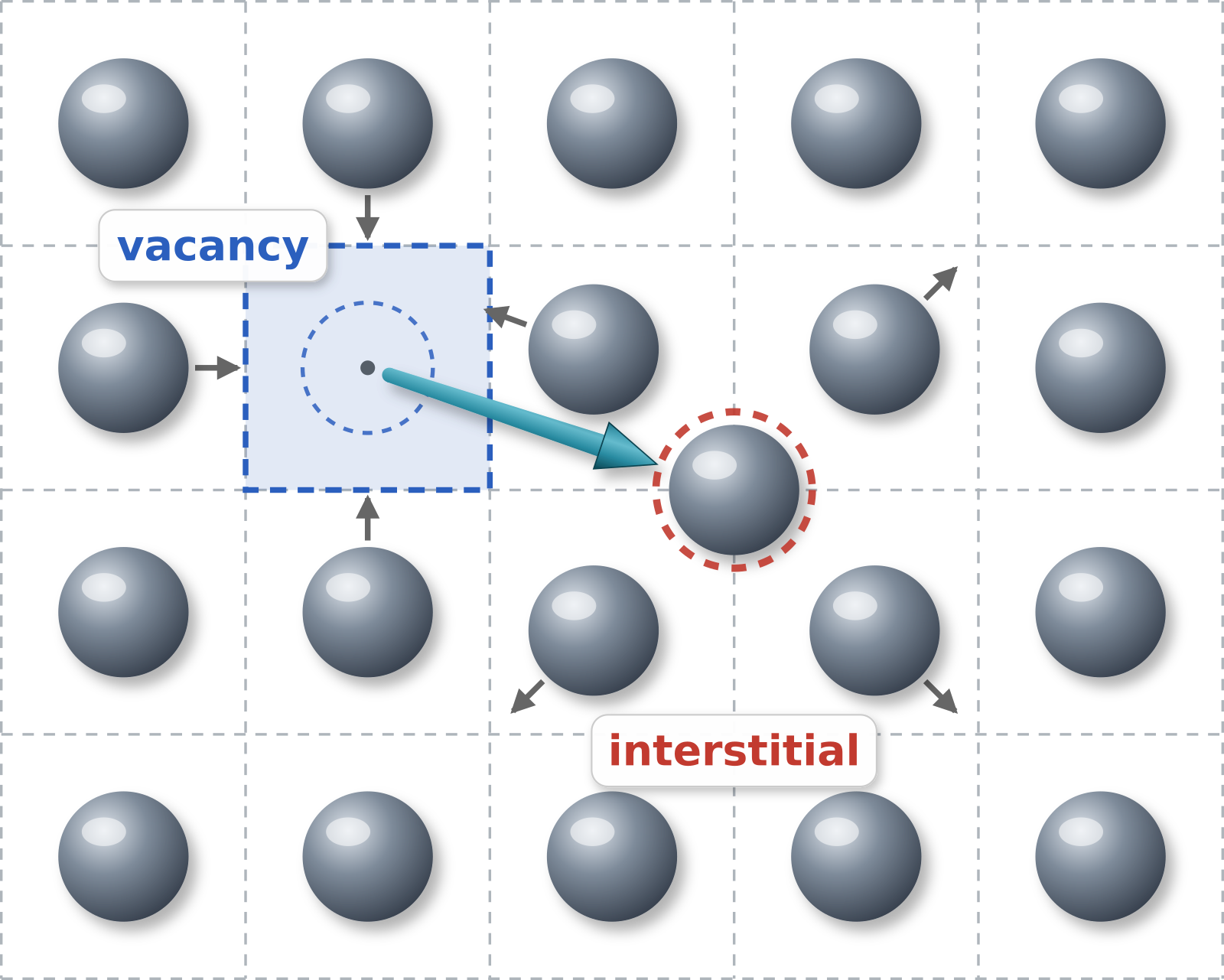
Schematic depiction of a Frenkel pair: an atom is displaced from its lattice site leaving a vacancy and gets squeezed in between the atoms of neighboring occupied lattice sites
The Wigner-Seitz cell of a lattice site is the region of space that is closer to that site than to any other site. Assigning every atom to its nearest reference site is therefore the same as assigning it to the Wigner-Seitz cell it falls into, and the occupancy of a site is the number of atoms that end up in its cell. Since the cells fill space without gaps or overlaps, every atom is assigned to exactly one of them. This construction is also known as a Voronoi tessellation of the lattice sites, and is the same one that compute voronoi/atom applies to the atoms themselves. A more detailed description can be found on the corresponding Wikipedia page.
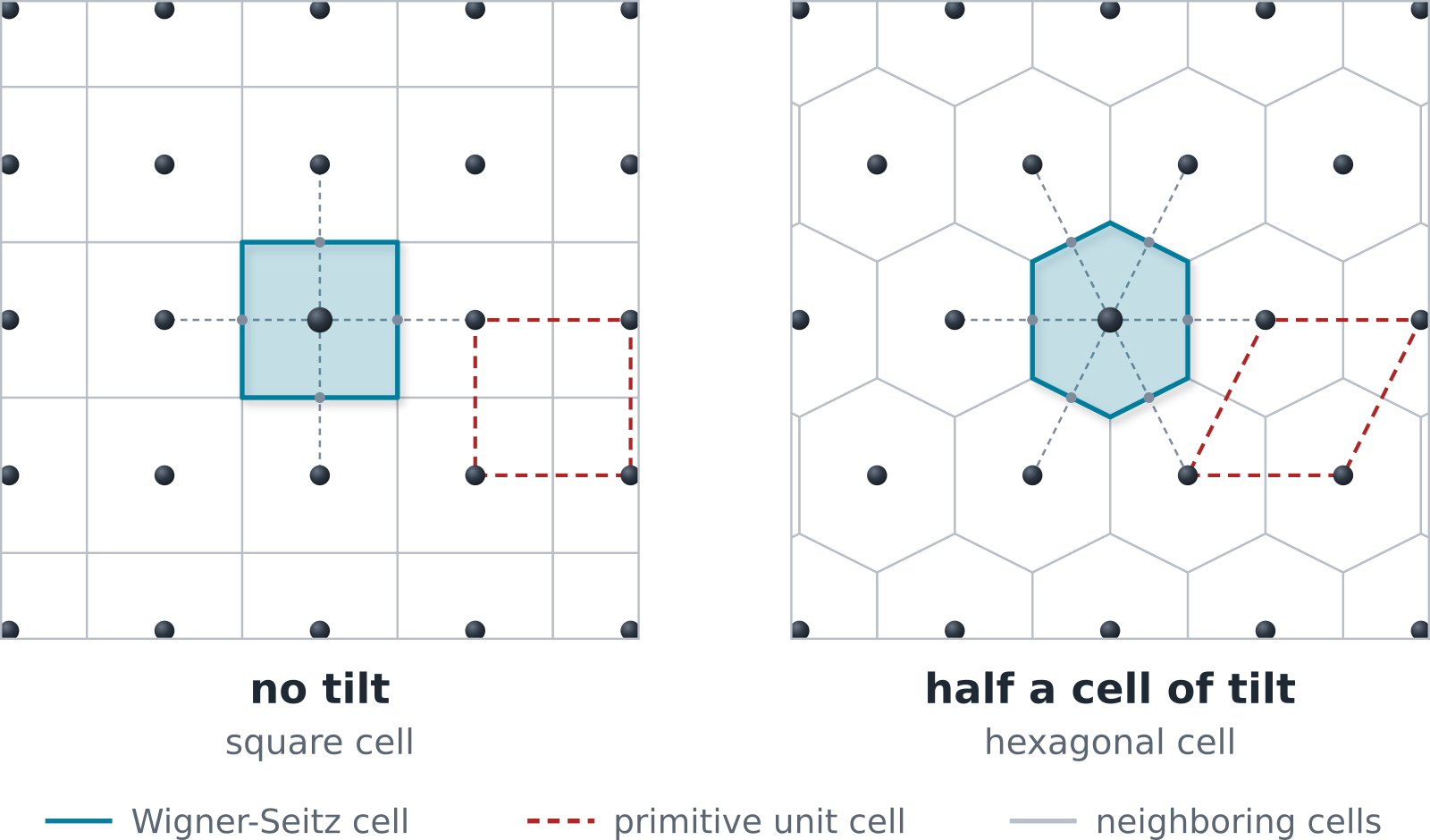
Wigner-Seitz cells of a two-dimensional lattice. Each cell is bounded by the planes that cut the connections to the neighboring sites (dashed) in half at a right angle, so the shape of the cell follows from the lattice alone: shearing the lattice by half a cell turns the square cell into a hexagonal one. A Wigner-Seitz cell covers the same area (in three dimensions, the same volume) as a primitive unit cell, but it is centered on a lattice site and has the full symmetry of the lattice.
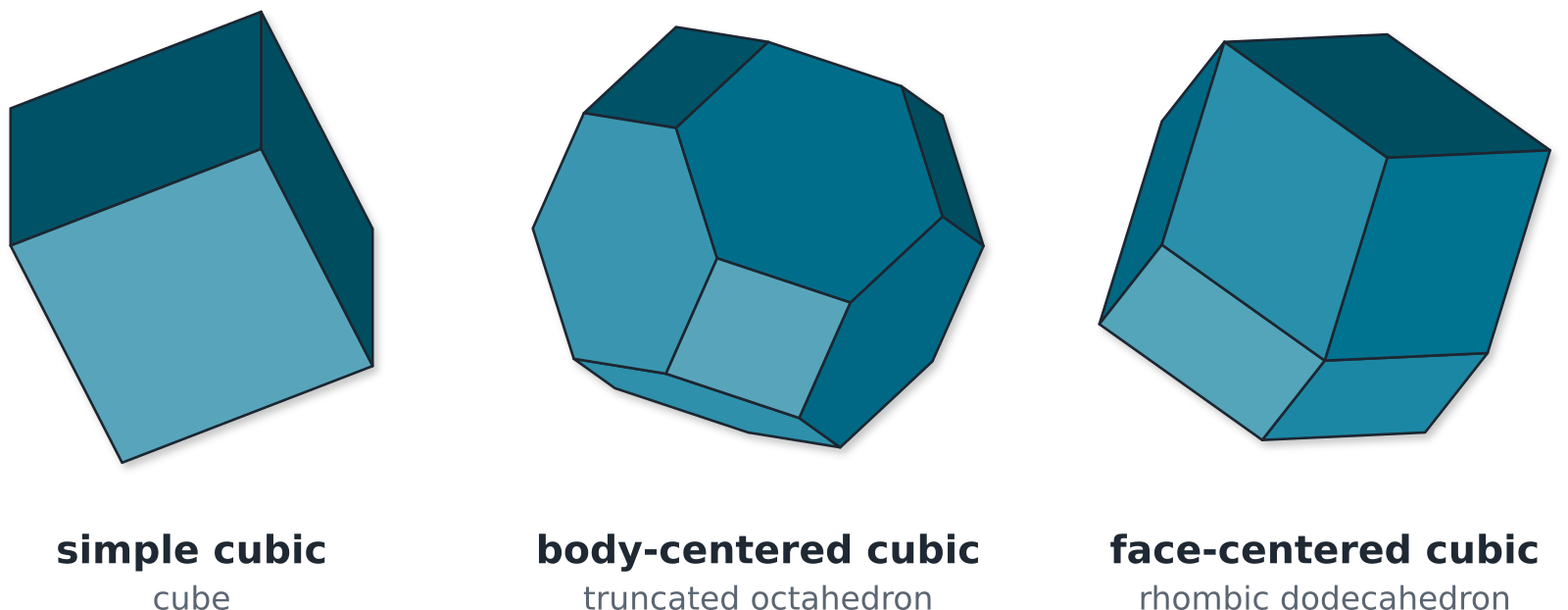
Wigner-Seitz cells of the three cubic lattices. The three cells are drawn at a common size and are not to scale relative to each other.
To find the nearest reference site of an atom quickly, the sites of each processor are sorted into a regular grid of bins, in the same way a neighbor list is built. An atom is mapped to its bin, the closest site in that bin is picked, and the list of neighboring sites of that site, which is built from the same bins, is followed until no closer site is found. Whether the atom is really inside the Wigner-Seitz cell of that site is then confirmed with the bisecting planes described above. The bins and the lists of neighboring sites are set up once at the beginning of a run and rebuilt only when the simulation box changes.
Nearby defective sites (0 or 2+ atoms) are further grouped into clusters. Two defective sites are connected when they are closer to each other than drvac if the second site is empty, or closer than drint if it holds more than one atom. A cluster is a group of defective sites that are connected in this way, either directly or through other defective sites of the same cluster. Every defective site therefore belongs to exactly one cluster and the clusters do not overlap. A cluster is identified by the smallest atom ID among its sites, and its position is the average of the positions of its sites.
The size of a cluster is the number of its interstitials minus the number of its vacancies, so the sign of the size distinguishes interstitial-type from vacancy-type clusters, and a cluster with as many vacancies as interstitials has a size of zero. A site holding more than two atoms counts as one interstitial, not as one per extra atom. Note that the identification and counting of the vacancies and interstitials themselves depends only on the number of atoms at each site, not on this clustering or the two distances.
The optional keywords listed above adjust the settings of the analysis.
The drvac and drint distances are specified as unitless multiples of the nearest neighbor distance of the reference lattice, not in distance units, so that the same setting has the same meaning for different lattices and different lattice constants. They default to 1.5 and 1.82, respectively. With those values a vacancy is connected to defects in the first two neighbor shells and a multiply occupied site to defects in the first three, and this is the case for simple cubic, bcc, and fcc lattices alike; the larger value for interstitials accounts for their spatially more extended configurations such as dumbbells. The nearest neighbor distance and the resulting two distances are printed at the beginning of each run. With rescale yes they follow the box, so that they remain the same multiples of the nearest neighbor distance of the rescaled reference lattice.
Use the region keyword to exclude reference sites where no atoms are expected. This is strongly recommended when parts of the simulation box are empty, for example the vacuum above a free surface in a non-periodic dimension, since otherwise every site in the empty space is counted as a vacancy. Such a mistake is not detected as such, but a warning is printed when more than 20 percent of the reference sites are found to be empty, which also catches a reference lattice that does not match the crystalline structure of the atoms.
Use rescale yes when the box changes size during the run (for example under fix npt or while heating), so that the reference sites expand and contract with the box and thermal expansion is not mistaken for defect formation. A warning is printed when the size of the box changes during a run while rescale is not enabled.
The reference sites never follow a change of the box shape, so shearing the box is not supported. A warning is printed when the box shape will change during a run, and combining a shearing box with rescale yes is an error.
With the site_file keyword the reference sites are not generated from the lattice but read from the given text file, which must contain one site per line as three coordinates “x y z” (anything following a “#” character is ignored). Blank lines and comment-only lines are skipped. This allows using a reference structure that is not a perfect lattice, for example the relaxed atom positions from the beginning of a simulation. A lattice command is still required, since the shape of the Wigner-Seitz cells and the nearest neighbor distance that drvac and drint refer to are derived from it.
Note
The lattice must match the crystal that the atoms actually occupy. If the lattice spacing or orientation is wrong, essentially every atom will be flagged as a defect. For a crystal at finite temperature it is usually best to use the thermally expanded lattice constant (or rescale yes), and to analyze the inherent structure (a quenched or minimized snapshot) when the thermal displacements are large.
In a restarted simulation this compute behaves like any other compute: the lattice and compute commands must be repeated in the input script and the reference sites are then regenerated at the beginning of the run. With rescale yes the lattice constant must be chosen to match the size of the box stored in the restart file.
This compute is described in (Hammond).
Output info
This compute calculates a global vector of length 3, a global array, a per-atom vector, and a local array.
The global vector holds, in order, the number of vacancies, the
number of interstitials, and the number of irregular sites (sites with
more than two atoms), each summed over all MPI processes. Thus
c_ID[1] is the number of Frenkel pairs, provided the crystal has no
sources or sinks for defects such as free surfaces or pre-existing
vacancies, since only then is the number of vacancies equal to the number
of interstitials.
The global array has 2 rows and 20 columns and is a histogram of the defect cluster sizes: row 1 counts vacancy clusters and row 2 counts interstitial clusters, with column k holding the number of clusters with a net content of k defects (clusters larger than 20 are added to the last column). Clusters containing as many vacancies as interstitials, i.e. Frenkel pairs that are about to recombine, have a net size of zero and are not included in the histogram.
The per-atom vector is the distance of each atom from its nearest lattice site, which can be used to color atoms in a dump image or to select displaced atoms. For atoms outside the compute group the value is 0.0.
The local array has 5 columns and one row per defect cluster owned by the MPI process: the cluster ID, the cluster size (negative for vacancy clusters, positive for interstitial clusters), and the x, y, z coordinates of the cluster center, i.e. the average position of the defective sites that make up the cluster. To avoid double counting, a cluster is stored only on the process whose subdomain contains its center. The array can be written with the dump local command.
The following excerpt from a displacement-cascade simulation in bcc iron started by giving a 2 keV recoil to a primary knock-on atom (PKA) uses compute frenkel to count and visualize the created Frenkel pairs.
lattice      bcc 2.8553                     # reference lattice for the WS analysis
compute      ke all ke/atom
compute      fr all frenkel
variable     vizstep index 100
variable     hot atom c_ke>0.5
variable     acol atom log(c_ke)
group        hot dynamic all var hot every ${vizstep}

fix          spheres all graphics/objects ${vizstep} &
                sphere 1 32.0 10.0 0.0 2.0 &
                sphere 2 50.0 20.0 0.0 2.0
fix          label   all graphics/labels  ${vizstep} &
                text "Frenkel pairs: $(c_fr[1]:% 4.0f)    Simulation time: $(time:% 5.1f) ps" &
                400 50 0 size 30 &
             colorscale viz "log(kinetic energy / eV)" 700 400 0 vertical length 600 tics 10 &
             text "Vacancy" 280 185 0 size 30  &
             text "Interstitial" 300 115 0 size 30
variable     acol atom log(c_ke)*v_hot

dump         viz hot image 100 frenkel-*.png v_acol type size 800 800 &
                 zoom 2.0 view 70 30 center s 0.5 0.5 0.4 &
                 shiny 0.2 fsaa yes box no 0.0 axes yes 0.5 0.05 &
                 compute fr type 0 2 fix label type 1 0 fix spheres type 0 0

dump_modify  viz pad 6 backcolor black backcolor2 white element Fe Fe Fe O &
             adiam * 2.5  color map2 0.342 0.062 0.429 color map3 0.736 0.216 0.330 &
             amap -0.5 1 cf 0.0 3 min map2 0.5 map3 max pink &
             acolor 1 steelblue acolor 2 darkgoldenrod
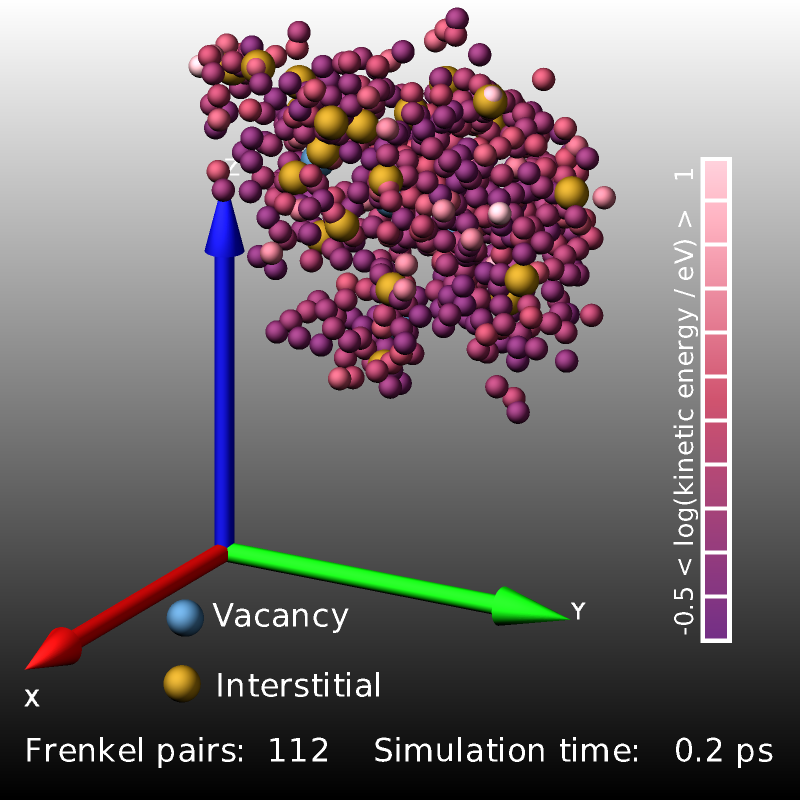
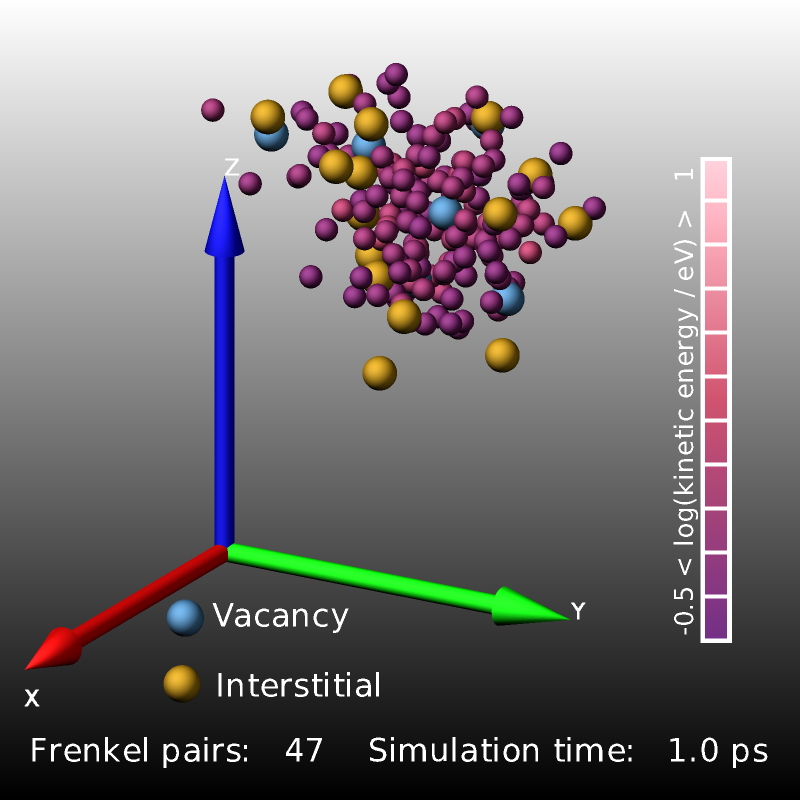
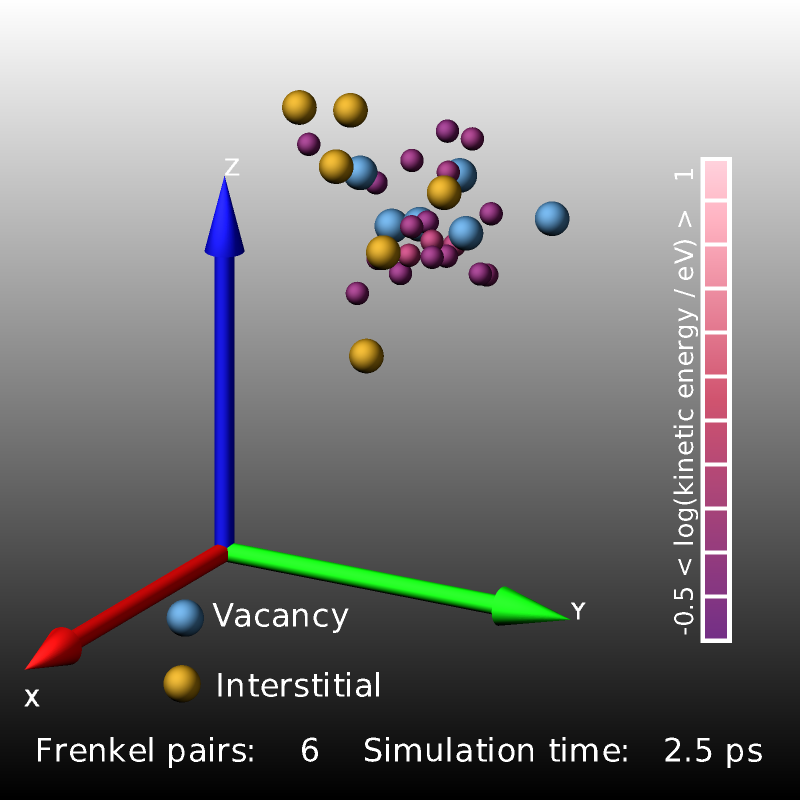
The images above are three snapshot images created by the LAMMPS input from above. Shown are atoms with elevated kinetic energy (smaller spheres, colored by their kinetic energy on a logarithmic scale) and the Frenkel pairs (larger spheres, blue: vacancies, yellow: interstitials). The cascade of collisions spreads and briefly “melts” a small region (0.2 ps) whose kinetic energy then quickly dissipates into the surrounding crystal (1.0 ps) and the system relaxes and the lattice reconstructs so that only a small number of Frenkel pairs survive.
Dump image info
Compute frenkel can be used with the compute keyword of dump image. It adds one sphere at the center of every defect cluster to the rendered image, so the spatial distribution of the damage is shown directly without an external visualization tool.
Each sphere carries a color index of 1 for a vacancy cluster and 2 for an interstitial cluster. With color style type or element these indices are mapped to the corresponding atom-type (or element) colors; with color style const all spheres use one color, which defaults to white and can be changed with dump_modify ccolor. The opacity defaults to fully opaque and can be changed with dump_modify ctrans.
To draw vacancies and interstitials in two distinct colors that are independent of the real atoms, define one or two extra atom types that no atoms actually use (give them a mass and a pair_coeff so the input is valid; since no atoms have those types they have no effect on the simulation) and color them with dump_modify acolor. For example, with the metal atoms on type 3 and types 1 and 2 reserved for the defect colors:
compute fr all frenkel
dump    d all image 1000 defect.*.jpg type type adiam 0.5 compute fr type 0 0
dump_modify d acolor 1 blue acolor 2 red acolor 3 gray atrans 3 0.1
Each cluster sphere is drawn with a diameter of 0.6 lattice spacings. The cflag2 setting is added to that diameter, which allows to enlarge the markers; the cflag1 setting is not used for spheres.
Changes to compute frenkel since its publication
This compute is derived from the implementation published in (Hammond). The Wigner-Seitz analysis itself is unchanged, but the command has been adapted to current LAMMPS conventions and its interface, one of its defaults, and its behavior in parallel differ from the published version. Input scripts written for the published version therefore need to be adjusted.
Output instead of extra particles. The published version came with a companion dump style that wrote out the identified defects as if they were particles, which required setting aside an atom type and a group for them. This version adds no particles and no dump style. Instead the defect clusters are available as a local array that can be written with the dump local command, and they can be drawn directly with the compute keyword of dump image, as described above. The frenkelgroup setting, which selected the group used for those particles, no longer exists.
The compute group is used. The published version analyzed all atoms. Here atoms outside the group of the compute are ignored and never count as occupants of a lattice site, which allows restricting the analysis to one species of a multi-component system, for example to the tungsten atoms of a tungsten crystal containing helium.
Settings are keywords of the compute command. The published version set drvac, drint, and the other options with the compute_modify command. They are now optional keywords of the compute command itself, as is customary for LAMMPS commands, and compute_modify no longer accepts them.
drvac and drint are unitless. The published version interpreted these two settings as distances and derived their defaults from the largest lattice spacing. For a lattice whose unit cell contains more than one site, however, the lattice spacing is not the distance between neighboring sites, and for a non-cubic unit cell there is no single lattice spacing at all. They are therefore now multiples of the nearest neighbor distance of the reference lattice, with the defaults described above. For a bcc lattice the defaults connect exactly the same neighbor shells as the published defaults did. For an fcc lattice the published default for drint also reached the fourth neighbor shell, which the new default no longer does, and for a simple cubic lattice the published default for drvac only reached the first neighbor shell, while the new default reaches the second one as documented.
Corrections. Several defects were found and fixed while adapting the code: the exchange of information between processors could stall for a defect cluster spanning several processor subdomains; the analysis could report defects that are not there after the simulation box had changed its size; and large settings of drvac or drint could crash the calculation.
Error checks. Combinations that the analysis cannot handle, namely comm_style tiled, fix balance, and rescale yes for a triclinic box, are now rejected with an error message. A warning is printed when the simulation box changes during a run while rescale is not enabled, and when the communication cutoff is smaller than the distance this compute needs to search.
Restrictions
This compute is part of the EXTRA-COMPUTE package. It is only enabled if LAMMPS was built with that package. See the Build package page for more info.
All atoms must have IDs and an atom map must be
defined (for example with atom_modify map array). A lattice must be defined to provide the reference sites; a general
triclinic lattice is not supported.
The shape of the Wigner-Seitz cell is determined from the surroundings of the first site of the unit cell and then used for all sites. This is exact when all sites of the lattice have the same surroundings, as for the simple cubic, body-centered cubic, and face-centered cubic lattices, and an approximation for a lattice whose unit cell contains sites with differently oriented surroundings, such as the diamond lattice.
This compute cannot be used together with comm_style tiled or fix balance, and the rescale option does not support triclinic simulation boxes. Each of these is rejected with an error message. A simulation box that changes its size or shape while rescale is not enabled, and a communication cutoff that is smaller than the distance this compute has to search, produce a warning.
Default
The drvac and drint distances default to 1.5 and 1.82 nearest neighbor distances, respectively; region = none, rescale = no, site_file = none.
(Hammond) Hammond, “Parallel point defect identification in molecular dynamics simulations without post-processing: A compute and dump style for LAMMPS”, Comput. Phys. Commun. 247, 106862 (2020).