pair_style mesomem/dipole command
Accelerator Variants: mesomem/dipole/omp
Syntax
pair_style mesomem/dipole
This pair style has no arguments. The cutoffs are set for each pair of atom types with the pair_coeff command.
Examples
pair_style mesomem/dipole
pair_coeff * * 1.0 1.0 15.0 1.0 2.5 2.0 5.0 0.0
pair_coeff 1 2 1.0 1.0 15.0 1.0 2.5 2.0 5.0 0.05
Example input scripts available: examples/PACKAGES/mesomem, https://gitlab.tudelft.nl/idema-group/mesomem
Description
Added in version TBD.
The mesomem/dipole style computes the MesoMem interaction (Sillano) for a solvent-free, one-particle-thick, coarse-grained model of fluid membranes. Each particle represents a patch of a lipid bilayer, and the direction of its dipole vector represents the local membrane normal. Unlike for pair_style ylz, where the orientation dependence multiplies the isotropic potential, this pair style adds tilt and splay energies, weighted by a smooth, short-ranged function of the distance, to a purely radial isotropic potential:
Here \(\mathbf{r}_{ij} = \mathbf{r}_i - \mathbf{r}_j\) is the distance vector between particles i and j, \(r = |\mathbf{r}_{ij}|\), \(\hat{\mathbf{r}}_{ij} = \mathbf{r}_{ij}/r\), and the unit vectors \(\mathbf{n}_i\) and \(\mathbf{n}_j\) point along the dipoles of particles i and j.
The isotropic part \(U_{iso}\) is
where \(\epsilon\) is the depth of the minimum at \(r = \sigma\), and \(r_c\) is the cutoff for this pair of atom types. The exponent \(\zeta\) controls the width of the attractive branch (larger values make it narrower) and thus the in-plane diffusivity of the particles within the membrane. For \(\zeta > 0.5\) the force goes smoothly to zero at \(r_c\).
The tilt and splay energies act only over a shorter distance and are switched off smoothly at the cutoff \(w_c\) by the weight function
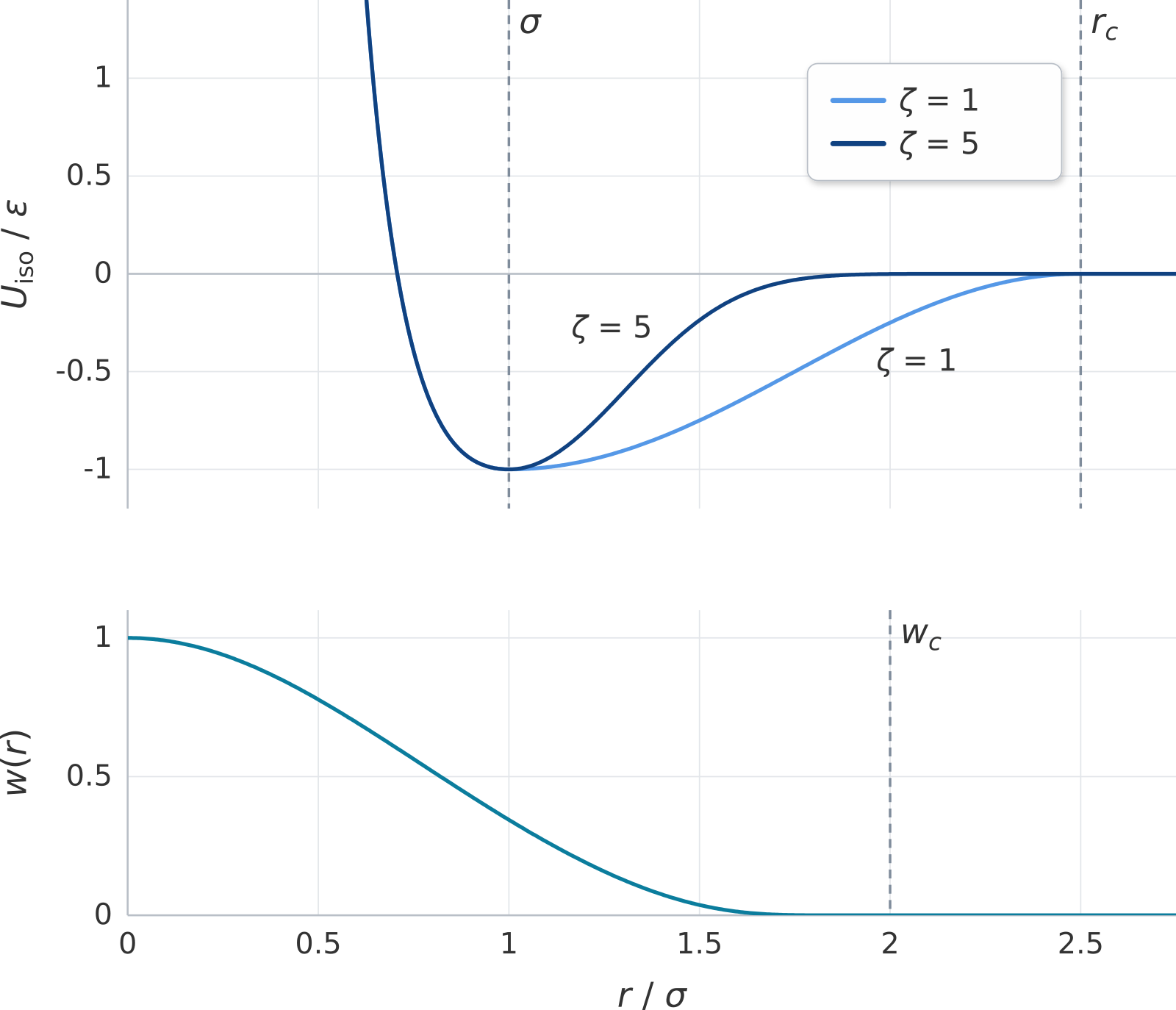
Isotropic potential \(U_{iso}(r)\) for two values of \(\zeta\) (top) and weight function \(w(r)\) for the tilt and splay energies (bottom), both for \(r_c = 2.5\,\sigma\) and \(w_c = 2\,\sigma\).
With the spontaneous curvature shift \(s = \tfrac{1}{2} r C_0\) and the tilt deviations \(d_i = \mathbf{n}_i \cdot \hat{\mathbf{r}}_{ij} + s\) and \(d_j = \mathbf{n}_j \cdot \hat{\mathbf{r}}_{ij} - s\), the tilt and splay energies are
where \(k_{tilt}\) and \(k_{splay}\) are the tilt and splay stiffness constants and \(C_0\) is the spontaneous curvature. Both energies are zero for the pair geometries shown in the figure below. For \(C_0 = 0\) this is a flat membrane, where both normals are parallel to each other and perpendicular to \(\mathbf{r}_{ij}\). For \(C_0 \ne 0\) both particles are located on a sphere of radius \(R = 1/|C_0|\) and their normals are tilted by the angle \(\alpha/2\) against the perpendicular to \(\mathbf{r}_{ij}\), with \(\sin(\alpha/2) = r |C_0|/2\). For \(C_0 > 0\) the normals point toward the center of curvature, i.e. the membrane prefers to bend toward the side the dipoles point to; for \(C_0 < 0\) they point away from it.
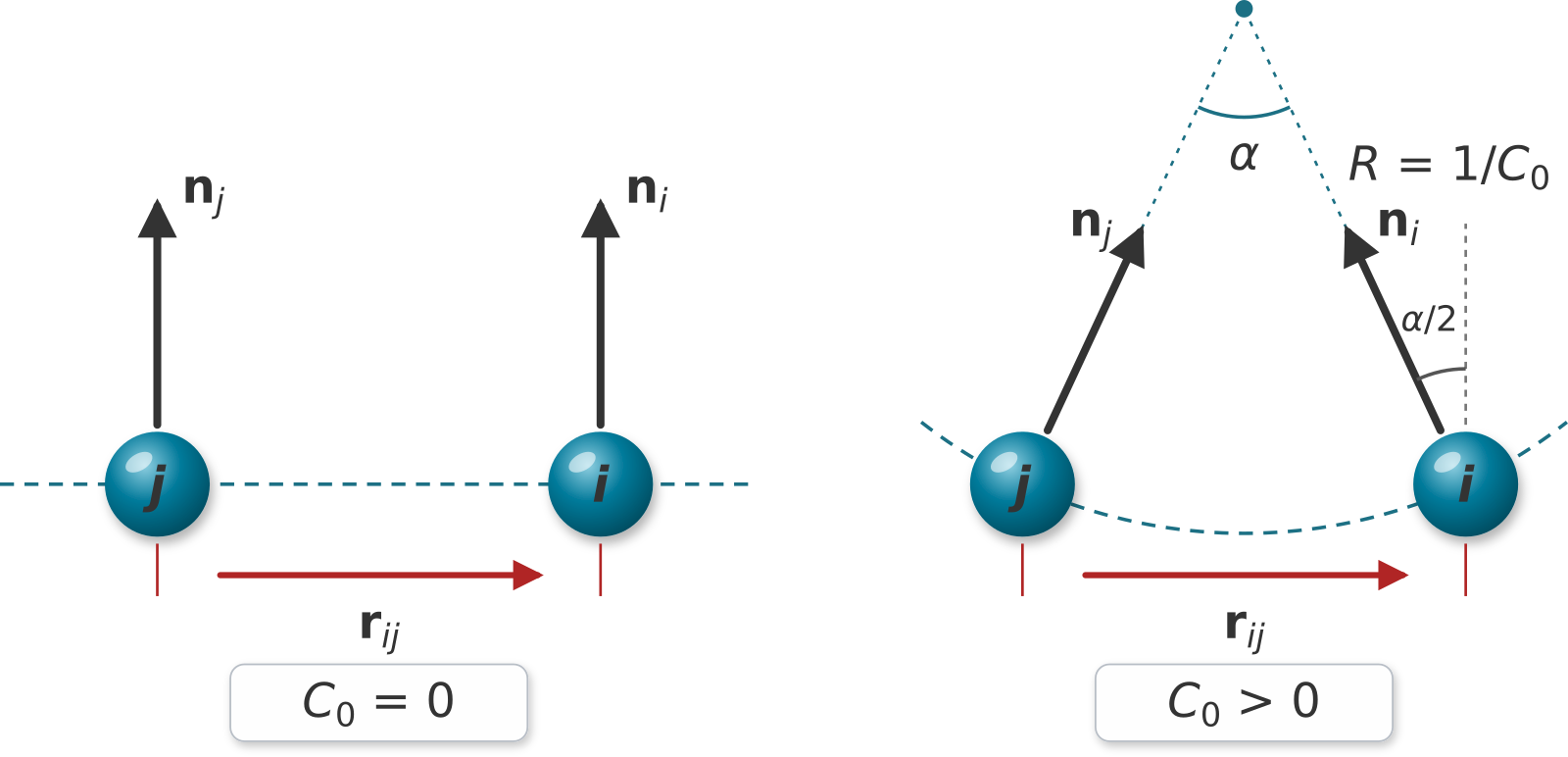
Pair geometries with zero tilt and splay energy for \(C_0 = 0\) (left) and \(C_0 > 0\) (right). The angle \(\alpha\) is exaggerated for clarity.
Particles with a zero length dipole moment vector interact with all other particles only through \(U_{iso}\).
Note
This pair style does not compute any electrostatic interactions; there are no charge-dipole or dipole-dipole terms. The dipole vector of atom_style dipole only serves to store the orientation of each particle, and its magnitude has no effect on this pair style.
Other commands treat the dipole vector as an electric dipole moment, for example fix efield or compute dipole. Their results are therefore only meaningful if the dipole vector is also meant to represent one. Electrostatic interactions between the dipoles can be added to the MesoMem interaction with pair_style hybrid/overlay and a point dipole pair style, for example pair_style lj/cut/dipole/cut with \(\epsilon = 0\). Then the magnitude of the dipole moments matters for the electrostatic part, but still not for the MesoMem part:
pair_style hybrid/overlay mesomem/dipole lj/cut/dipole/cut 2.5 5.0
pair_coeff * * mesomem/dipole 1.0 1.0 15.0 1.0 2.5 2.0 5.0 0.0
pair_coeff * * lj/cut/dipole/cut 0.0 1.0
The following coefficients must be defined for each pair of atom types via the pair_coeff command as in the examples above, or in the data file or restart files read by the read_data or read_restart commands:
\(\sigma\) (distance units), \(\sigma > 0\)
\(\epsilon\) (energy units)
\(k_{tilt}\) (energy units)
\(k_{splay}\) (energy units)
\(r_c\) (distance units), \(r_c > \sigma\)
\(w_c\) (distance units), \(0 < w_c \le r_c\)
\(\zeta\) (unitless), \(\zeta \ge 0.5\)
\(C_0\) (inverse distance units)
All eight coefficients must always be specified.
To integrate the rotational motion of the particles, use a time
integration fix that updates the dipole orientation, for example
fix nve/sphere or
fix nvt/sphere with the update dipole keyword,
or fix brownian/sphere. When adding a
fix langevin thermostat, use the omega yes
keyword to also thermalize the rotational degrees of freedom. The
rotational dynamics depends on the moment of inertia of the particles,
which is determined by their mass and diameter; the diameter does not
enter the pair interaction. An example input is in the
examples/PACKAGES/mesomem directory.
Styles with a gpu, intel, kk, omp, or opt suffix are functionally the same as the corresponding style without the suffix. They have been optimized to run faster, depending on your available hardware, as discussed on the Accelerator packages page. The accelerated styles take the same arguments and should produce the same results, except for round-off and precision issues.
These accelerated styles are part of the GPU, INTEL, KOKKOS, OPENMP, and OPT packages, respectively. They are only enabled if LAMMPS was built with those packages. See the Build package page for more info.
You can specify the accelerated styles explicitly in your input script by including their suffix, or you can use the -suffix command-line switch when you invoke LAMMPS, or you can use the suffix command in your input script.
See the Accelerator packages page for more instructions on how to use the accelerated styles effectively.
Mixing, shift, table, tail correction, restart, rRESPA info
This pair style does not support mixing. Coefficients for all pairs of atom types, both I = J and I != J, must be set explicitly. Data files that can be read back must therefore be written with the pair ij option of the write_data command.
The pair_modify shift option is not needed, since the energy of this pair style goes to zero at the cutoff. The pair_modify table and tail options are not relevant for this pair style.
This pair style writes its information to binary restart files, so pair_style and pair_coeff commands do not need to be specified in an input script that reads a restart file.
This pair style can only be used via the pair keyword of the run_style respa command. It does not support the inner, middle, outer keywords.
Restrictions
This pair style is part of the DIPOLE package. It is only enabled if LAMMPS was built with that package. See the Build package page for more info.
This pair style requires the per-atom attributes mu and torque, as provided for example by atom_style hybrid sphere dipole. With that atom style, a per-type mass must also be set with the mass command (or in the data file), even though only the per-atom masses are used.
Default
none
(Sillano) Sillano, Marrink, Idema, Phys. Rev. E, 114, 034412 (2026).