fix graphics/chunk command
Syntax
fix ID group-ID graphics/chunk Nevery chunkID keyword args ...
ID, group-ID are documented in fix command
graphics/chunk = style name of this fix command
Nevery = update graphics information every this many time steps
chunkID = ID of compute chunk/atom command
zero or more keyword/args pairs may be appended
keyword = alpha or clip or maxreplace or shading or radius or mindist or region
alpha value = override multiplier for alpha shape extraction (distance units)
clip value = truncate point cloud to box boundaries if yes, otherwise use all points
maxreplace value = set the largest cluster size up to which atoms are replaced by icosahedra
shading value = smooth or flat
   smooth = compute per-vertex normals for smooth shading (default)
   flat = use face normals for flat shading
radius value = override per-atom or per-type radius if > 0.0 (distance units, default 0.0)
mindist value = override automatic distance cutoff for slitting clusters (distance units)
region value = region-ID
  region-ID = ID of region that atoms must be in to be visualized
Examples
compute cc1 all chunk/atom molecule
fix hull all graphics/chunk 100 cc1
fix hull all graphics/chunk 100 cc1 radius 1.0 shading smooth region upper
fix hull all graphics/chunk 100 cc1 shading flat alpha 10.0 maxreplace 50
Description
Added in version 4Jul2026.
This fix generates graphics objects from chunks of atoms defined by the compute chunk/atom command. For each chunk a point cloud is created from the atom positions. By default, for clusters with up to 100 atoms, each atom is replaced by the the positions of an icosahedron scaled to the radius of the atom. For larger clusters the point cloud only uses atom positions that shifted away from the center of the cluster by the atom radius. The threshold value can be set by the maxreplace keyword. A triangulated surface is created from that point cloud using a 3-D Delaunay triangulation combined with alpha shape extraction. This allows the resulting surface to follow the shape of the chunks. The resulting list of graphics objects is passed to dump image for rendering via the fix keyword.
The positions used for the generation of the graphics are based on coordinates for local and ghost atoms where then redundant generated triangles are not drawn. When a cluster straddles a periodic boundary it should be drawn in parts on both sides of the boundary.
If available, the per-atom radius (e.g. for simulations using atom style sphere) is used, otherwise - if available - half of the value of the Lennard-Jones sigma parameter for the atom type is used. If neither is available, half of the lattice spacing in x-direction is used as estimate for atom radii.
The group-ID selects the atoms included in the hull computation. Only atoms that belong to the specified group and are assigned to a chunk are considered.
The Nevery keyword determines how often the list of the graphics objects is recomputed. It should match the dump frequency of the corresponding dump image command.
The color of the graphics objects depends on the coloring scheme selected in dump image command. With the type or element coloring scheme the color is based on atom type as described below, with the const coloring scheme a uniform color is used instead. This color can be set with the fcolor keyword of the dump modify command. When using atom type based colors the vertices of the surface are colored using the atom type of the closest atom and the color between vertices is interpolated.
If the optional region keyword is used, only atoms in the specified geometric region are used for constructing the hull.
The optional radius keyword allows to override the radius value used to determine the size of the represented graphics by scaling the octahedron positions that represents each atom for computing the surface.
The optional alpha keyword allows to adjust the alpha shape extraction algorithm which determines how closely the generated triangulation follows the shape of chunks of atoms. It should be at least about 3x the average distance of closest neighbors. For larger values, the generated shape will become smother and more like a conventional convex hull. A value of 0.0 (the default) triggers an estimation of a suitable value from the average nearest neighbor distance.
The optional clip keyword allows to adjust the behavior for chunks that straddle periodic boundaries. With the default value of yes all points are that are outside the simulation box are not used in the triangulation. When clip is set to no all points of ghost atoms that are outside the simulation box will be included in the triangulation. Typically, a value of yes would be used with large chunks and no might be preferred for small chunks.
The optional maxreplace keyword allows to define up to which chunk size atoms positions are replaced by those of an icosahedron to produce smoother surfaces. For larger chunks, this step has few advantages and can slow down the triangulation significantly.
The optional mindist keyword allows to override the heuristics used to split larger chunks when parts of it are scattered through the simulation box. The default value is 4x the largest radius in the system.
The optional shading keyword selects how triangle normals are determined for rendering surfaces. The smooth setting (the default) computes averaged per-vertex normals so that adjacent triangles appear curved and blend smoothly (except for sharp edges). The flat uses the face normal for all three corners of each triangle, giving the surface a faceted appearance.
Usage example
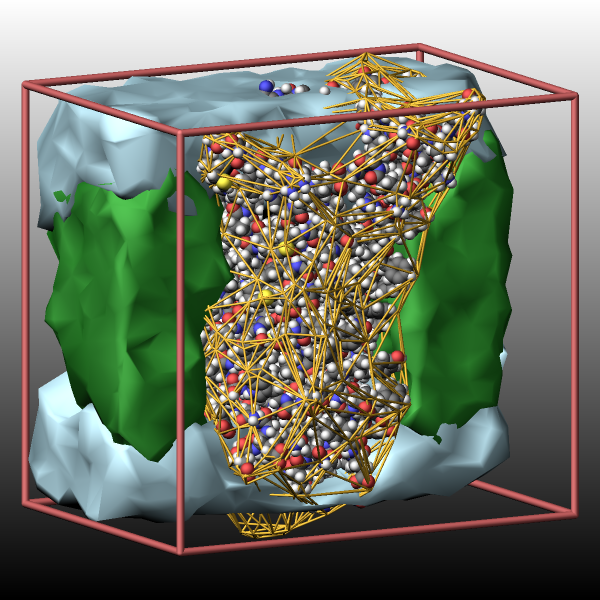
The commands below demonstrate a more complex usage of the
graphics/chunk fix by using fix property/atom to assign a custom property to atoms which is used
to define the chunks. These are commands that are added to the
in.rhodo input in the bench folder. The full input is available
in the examples/GRAPHICS folder.
# get a slice of the box in x-direction
region slice block $(xlo) $(xlo+0.6*lx) INF INF INF INF

# assign custom integer values to atoms, so we can
# group them into chunks by collections of atom types
fix   0 all property/atom i_chunk ghost yes
set type *     i_chunk 0  # default -> not part of a chunk
set type 1*35  i_chunk 1  # protein
set type 54*68 i_chunk 1  # chromophore
set type 4     i_chunk 2  # solvent (water plus Na Cl)
set type 33    i_chunk 2  # - "" -
set type 52*53 i_chunk 2  # - "" -
set type 36*51 i_chunk 3  # lipids

# define groups for individual subsets
group protein  type 1:3 5:32 34 35 54:68
group water    type 4 33 52 53
group lipid    type 36:51
group other    subtract all protein

# access the custom property and define chunks with it
compute ichunk all property/atom i_chunk
compute hull   all chunk/atom c_ichunk

# use three different fixes so we can use different settings
fix hull1 protein graphics/chunk 100 hull alpha 10.0
# use a box slice to restrict the triangulation to part of the box
# use clip option to cleanly truncate at the periodic box boundary
fix hull2 water   graphics/chunk 100 hull region slice alpha 6.0 clip yes
fix hull3 lipid   graphics/chunk 100 hull region slice alpha 6.0 clip yes

# compute rotation angle for slow rotation around z axis
# this needs 20000 steps for a full 360 degrees.
variable rot equal ((step/1000*18+180)%360)-180

# the fix vvvvvv  group selects atoms to be show, but does not affect fix graphics
dump viz protein image 100 myimage-*.png element type size 600 600 zoom 1.5 &
      shiny 0.2 fsaa yes bond atom 0.20 view 80 v_rot box yes 0.025 &
      fix hull1 const 2 0.4 fix hull2 const 1 0 fix hull3 const 1 0
#         ^^^ wireframe ^^^         ^^^ smooth triangle surfaces ^^^

# set elements for atom colors and define diameters for space filling spheres
dump_modify viz pad 9 boxcolor indianred backcolor black backcolor2 white &
  element H H H H H H H H H C C C C C C C C C C C C C N N N N N N N O O O O S S H H H H H C C C C C C N O O O P Cl Na H H H N C C C C C C C C C C C &
adiam 1*9 1.92 adiam 10*22 2.72 adiam 23*29 2.48 adiam 30*33 2.432 adiam 34*35 2.88 &
adiam 36*40 1.92 adiam 41*46 2.72 adiam 47 2.48 adiam 48*50 2.432 adiam 51 2.88 &
adiam 52 3.632 adiam 53 2.176 adiam 54*56 1.92 adiam 57 2.48 adiam 58*68 2.72 &
 fcolor hull1 goldenrod fcolor hull2 lightblue fcolor hull3 forestgreen
#  ^^^^ assign colors for triangulated graphics ^^^^^

run             20000
Dump image info
Fix graphics/chunk is designed to be used with the fix keyword of dump image. The fix constructs a list of graphics objects based on the size and geometry of the chunks in the fix group and passes the information to the image rendering facility.
The fflag1 setting of dump image fix determines whether the surface is rendered as connected rounded triangles (1) or as a wireframe mesh of cylinders (2). If using a wireframe mesh, the fflag2 setting determines the diameter of the cylinders.
Restart, fix_modify, output, run start/stop, minimize info
No information about this fix is written to binary restart files.
None of the fix_modify options apply to this fix.
Restrictions
This fix is part of the GRAPHICS package. It is only enabled if LAMMPS was built with that package. See the Build package page for more info.
This fix is not compatible with 2d simulations.
When running in parallel, the chunks and corresponding graphics objects are currently computed separately for each subdomain, so that the graphics will be different for all chunks that are distributed across sub-domains depending on the number of processors used.
Defaults
radius = 0.0 (= auto-detect), alpha = 0.0 (= auto-detect), shading = smooth, maxreplace = 100, clip = yes, mindist = (automatic: 4x largest radius in system)