\(\renewcommand{\AA}{\text{Å}}\)
fix symmetry command
Syntax
fix ID group-ID symmetry file keyword value ...
ID, group-ID are documented in fix command
file = path to a symmetry-data file describing the space group and orbit map
zero or more keyword/value pairs may be appended
keyword = tol
tol value = epsilon
  epsilon = fractional-coordinate tolerance
Examples
fix sym all symmetry symgroup.pm.json
fix sym all symmetry symgroup.fm-3m.json tol 1.0e-8
Example input scripts available: examples/PACKAGES/symmetry
Description
Added in version TBD.
This fix constrains a molecular dynamics simulation to obey a chosen crystallographic space-group symmetry at every timestep. The algorithm follows (Cox), and the LAMMPS implementation is derived from the symd reference implementation.
Atoms are organized into orbits. Each orbit has one asymmetric representative and one image atom per non-identity operator of the declared space group. Per step the fix:
averages the forces and velocities of the atoms in each orbit (mapped back to the asymmetric unit through the operator inverses) and redistributes the symmetrized values to every image, and
re-folds the image positions from the asymmetric representative using the affine operators to cancel numerical drift.
The user is responsible for setting up the data file so that the full unit cell is already present and consistent with the symmetry at the start of the run; the fix verifies this at init within tol.
Purpose and typical use
Ordinary molecular dynamics almost never preserves an exact crystallographic symmetry: thermal fluctuations and round-off break it within a few steps, and the trajectory drifts to whatever nearby lower-symmetry arrangement the forces prefer. This fix instead makes the space group an input setting and keeps every configuration exactly symmetric throughout the run. It is the dynamical counterpart of the symmetry-constrained structure searches common in crystallography, and differs from a harmonic symmetry restraint (which merely biases the system to stay near symmetric) in that no symmetry-breaking motion is possible at all.
The method used by the fix was introduced for crystal-structure prediction and enumeration in (Cox). Because there is a finite number of space groups, one can run the same system under each candidate group and relax it to obtain the symmetric structure compatible with that group; comparing the resulting energies (and testing which structures survive a subsequent unconstrained run) identifies stable and metastable polymorphs. Other suggested uses are modeling highly symmetric biological assemblies and, more generally, any study in which a particular symmetry is to be imposed by construction, for instance to prevent a metastable structure from collapsing during equilibration. Symmetric MD is a special case of objective molecular dynamics.
A practical workflow is: build the fully symmetric unit cell, run under the fix to relax/equilibrate it on the symmetric manifold, then remove the fix and continue in ordinary MD to test whether the structure is (meta)stable or breaks symmetry.
Parallel efficiency and system size
Unlike the symd reference engine, which integrates only the asymmetric unit and treats the images as non-integrated ghost particles, this fix keeps the entire unit cell as ordinary, fully integrated LAMMPS atoms and re-imposes the symmetry every step by symmetrizing their forces, velocities, and positions. The constraint that results is the same, but the bookkeeping fits LAMMPS’s domain decomposition without special-casing the images in the neighbor lists, force kernels, or communication.
The fix works unchanged in serial and in parallel and adds very little
overhead. Its per-step work is a local pass over the declared atoms
plus three fixed-size MPI_Allreduce calls (the per-orbit force sum,
the velocity sum, and the asymmetric-unit positions). The fix
introduces no pairwise or long-range communication of its own and never
migrates atoms between ranks. An orbit whose representative and images
are spread across different subdomains is handled correctly: each rank
contributes the atoms it owns to the per-orbit sums and reads back the
global result.
Consequently the fix is not restricted to tiny systems – it runs at essentially the cost of unconstrained MD for the same atom count, and the dominant expense remains the normal force evaluation. The characteristic setups are nonetheless modest in size (one asymmetric unit tiled by the group order \(|G|\), so from a few up to some tens of atoms per unit cell in the reference study), but nothing in the implementation caps the system size.
Note
Because all image atoms are integrated as normal atoms, they contribute to the kinetic energy and therefore to the temperature reported by compute temp and used by thermostats. The images move as rigid symmetry copies of their asymmetric representative, so the number of independent degrees of freedom is smaller than \(3N\) – it is \(D\,(n-1)\) for a general-position orbit set (with \(n\) the asymmetric-unit size and \(D\) the dimensionality), reduced further by any Wyckoff-site constraints (Cox). This fix does not subtract those redundant and constrained degrees of freedom from the count LAMMPS uses for temperature, so a thermostat controls the temperature of the full tiled cell rather than of the independent coordinates; since this number does not change during a run, it can be adjusted using compute_modify extra/dof. The provided examples avoid this issue and use fix nve.
Special positions (Wyckoff sites)
Atoms sitting on a special position (a mirror plane, axis, or inversion center) are invariant under one or more non-identity operators of the space group. To declare such an atom, set its orbit’s tags slot at every stabilizer-op index equal to the asymmetric tag and list those op indices in a per-orbit site_symmetry array (see the file-format section). Per step the fix then applies a Lagrange-multiplier projection that drives the asym atom’s fractional position and velocity back onto the constraint subspace defined by its stabilizer. The pseudo-inverse used for the projection is pre-computed at init from a Jacobi eigen- decomposition of \(B = \sum_k (R_k - I)^T (R_k - I)\) over the stabilizer ops.
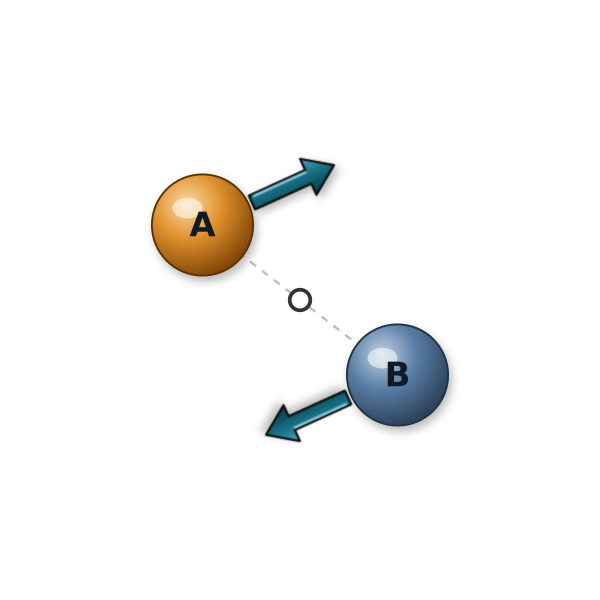
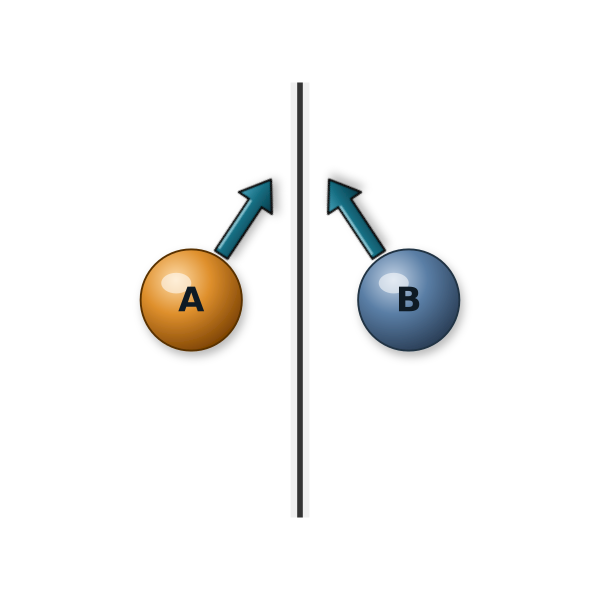
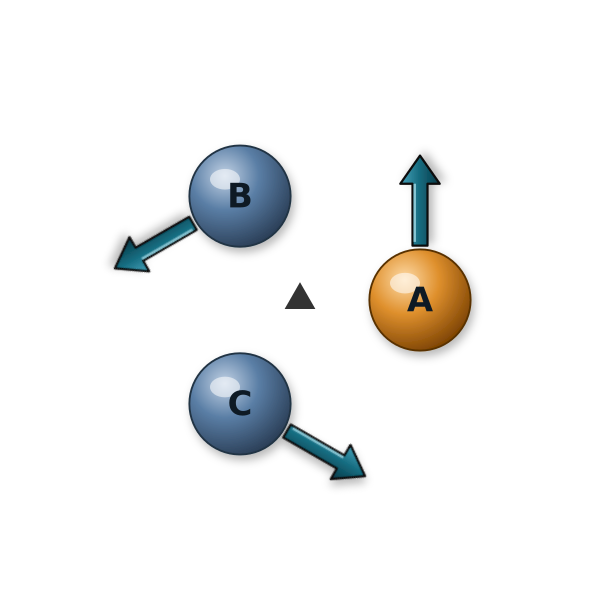
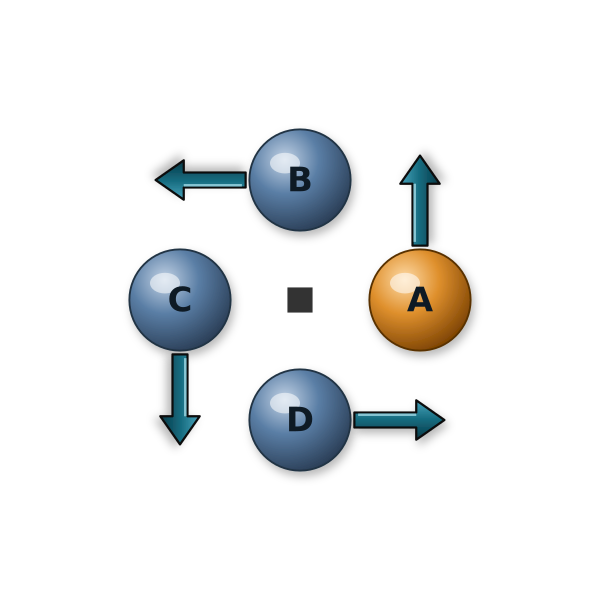
The figures above show how fix symmetry treats orbits for four example operators. In each panel the asymmetric representative A (amber) and its images (B, C, D, blue) are related by the operator - an inversion center, a mirror plane, a 3-fold rotation axis, or a 4-fold rotation axis. In each timestep the fix maps the images’ forces and velocities back onto A through the operator, inverses, averages them, and redistributes the symmetric result, so each image carries the operator applied to A’s force and velocity (arrows); image positions are re-folded from A the same way. An orbit contains one image per non-identity operator, so its size is the group order (2, 2, 3, and 4 here).
Symmetry-data file format
The file is in JSON format with the top-level schema:
{
  "group_name": "Pm",
  "lattice":    "monoclinic",

  "ops": [
    { "R": [[1, 0, 0], [0,  1, 0], [0, 0, 1]],
      "t": [0, 0, 0] },
    { "R": [[1, 0, 0], [0, -1, 0], [0, 0, 1]],
      "t": ["0", "0", "0"] }
  ],

  "orbits": [
    { "tags": [1, 2] },
    { "tags": [3, 4] },
    { "tags": [5, 5], "site_symmetry": [2] }
  ]
}
latticemust be one oftriclinic,monoclinic,orthorhombic,tetragonal,hexagonal,trigonal,cubic.Operators act on fractional coordinates: \(s' = R \cdot s + t\).
Ris an integer-valued lattice operator with \(|\det R| = 1\).tcomponents accept either JSON numbers (0.5) or rational strings ("1/2").The first entry in
opsmust be the identity. The full operator list must be closed under composition modulo lattice translations; the fix verifies this at init.Each orbit’s
tagsarray is parallel toops:tags[0]is the asymmetric representative andtags[k]for \(k \ge 1\) is the atom tag related to it byops[k]. For atoms on Wyckoff special positions, settags[k]equal totags[0]for every opkin the stabilizer and list those op indices (1-based, excluding 1) in an optionalsite_symmetryarray on the same orbit. The fix verifies at init that each declared Wyckoff atom actually sits on its constraint manifold to within tol.Any JSON key not listed above (for example fields starting with
_comment) is silently ignored, so the file can carry documentation inline.
LAMMPS provides a JSON schema file for symmetry files in the tools/json folder. Using the schema file the files can be validated to be conforming to the syntax requirement and conventions without running LAMMPS. Please note that the format requirement for JSON files in general are very strict and the JSON reader in LAMMPS does not accept JSON files with extensions like comments. Validating a particular JSON format symmetry file against this schema ensures that both, the JSON syntax requirement and the LAMMPS conventions. LAMMPS should be able to read and parse any JSON file that passes the schema check. This is a formal check only and thus it cannot check whether the file contents are consistent or physically meaningful.
Adapting JSON files from the symd reference engine
The JSON format used here is not the format used by the symd reference engine. symd’s
space-group tables (python/symd/data/{2,3}dgroups.json) describe
each group in abstract crystallographic terms. To use a symd entry in a
fix symmetry file you have to convert it in three steps:
Lattice family – lowercase the symd
latticestring. symd uses"Triclinic"; this fix wants"triclinic".Operators – expand each
genposstring into an explicit \((R, t)\) block. The expression"x,y,z"means the identity \(R = I, t = 0\). The expression"-x+1/2, y, -z"means{ "R": [[-1, 0, 0], [0, 1, 0], [0, 0, -1]], "t": ["1/2", 0, 0] }
In general each comma-separated component is an affine combination of
x,y,z(coefficients +/- 1 or 0, giving one row of \(R\)) plus an optional rational constant (one component of \(t\)). Rational strings ("1/2") are preferred over decimal approximations to preserve exactness through the parser. The firstgenposentry is required to be the identity by both formats.Orbits and Wyckoff sites – symd auto-generates image atoms from an asymmetric unit; this fix does not. You have to place the full unit cell yourself (in the LAMMPS data file or via
create_atoms) and then list every orbit explicitly:For each general-position asymmetric atom with tag
T, build atagsarray of length equal to the number of operators, withtags[k]set to the tag of the atom you placed at \(R_k \cdot s_T + t_k\). The fix verifies this layout at init.For each atom you place on a symd
specpossite, also declare thesite_symmetryarray on its orbit. The stabilizer ops are those \(R_k\) for which \(R_k \cdot s + t_k \equiv s\) (modulo lattice translations) at the special-position coordinates. For Wyckoff site “h” in the example above (1/2,1/2,1/2under P-1), op 2 (inversion) fixes the site, so the orbit reads{ "tags": [T, T], "site_symmetry": [2] }.
A few Python conversion scripts for generating symmetry files are available
alongside the example in the examples/PACKAGES/symmetry/ folder.
Restart, fix_modify, output, run start/stop, minimize info
No information about this fix is written to binary restart files. None of the fix_modify options are relevant to this fix. No global or per-atom quantities are stored by this fix for access by various output commands.
This fix can be used with run_style respa. Force symmetrization is applied at every RESPA level so each per-level force contribution is individually symmetric; position re-folding and Wyckoff projection still run once per outer step in end_of_step.
This fix is not invoked during energy minimization.
Restrictions
This fix is part of the EXTRA-FIX package. It is only enabled if LAMMPS was built with that package. See the Build package page for more info.
The full unit cell (asymmetric atom plus all images) must already be present in the system at the start of the run; the fix does not create atoms.
The simulation box must be compatible with the declared lattice family. When using fix npt or fix box/relax the user must select a coupling (e.g. iso, aniso, tri) that preserves the Bravais lattice type; the fix does not project box deformation onto the symmetric subspace.
Warning
Do not apply fix symmetry to atoms that are at the same time controlled by another fix which enforces its own rigid-body constraints or fixed bond and angle geometries, such as fix rigid and its variants, fix shake, fix rattle, or fix ilves. Fix symmetry and each of those constraint algorithms independently overwrite the forces, velocities, and/or positions of the affected atoms every step with no coordination between them, so they interfere and neither the rigid geometry nor the imposed symmetry is reliably maintained. There is no automatic check for this overlap. Combining such fixes with fix symmetry is only safe when they act on disjoint sets of atoms; atoms not listed in the symmetry file are left untouched by fix symmetry.
Default
tol = 1.0e-6.
(Cox) Cox and White, J. Chem. Theor. Comput., 18, 4077 (2022).